Why Businesses That Don't Do Marketing Definitely Do Marketing
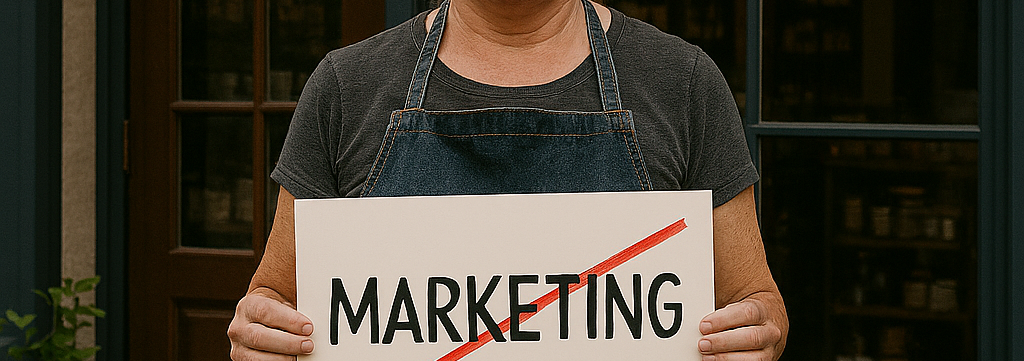
Have you ever come across a business that claims that it doesn't "do marketing"?
Sometimes they're even proud of the fact that they don't "do marketing".
But they’re wrong.
Too many otherwise smart and successful people just confuse marketing with advertising. Actually, advertising is just a small, but very prominent, piece in marketing’s bigger universe.
Marketing is the discipline of business growth.
it’s about building the foundations on which a business can flourish and grow.
If you’ve ever considered what product to launch, or who might buy it, you’ve done marketing.
If you think about your ideal customer, segment your market, make choices about where to focus, you've done marketing.
What most businesses call “marketing” is only the visible tip: promotion, campaigns, creative ideas.
Underpinning all that sits planning, research and strategy, the bits most people ignore, yet without which the rest is just hit and hope decoration.
Whenever I begin with a new client, the first step is simple: we need to understand how they see themselves, and how they think their customers and see them.
We do a workshop, Post-its on the wall under three columns: Company, Competitors, Customers. It’s informal, messy and unlocks truths that a more formal setting just can't.
The next step is to question wether your perceptions are matched by your customers. That’s where customer research comes in. Depending on budget, we may run a buyer survey, ask people who’ve purchased from the category about their preferences, unmet needs, and awareness of brands. If budgets are tighter, interviews and simpler surveys still yield necessary insight.
This isn’t just theory. It shows who’s buying (and why), who else they consider, and what they take away from each experience. You discover your competitive set, your actual position in the market, and what customers expect from you.
Ideal customer profiles emerge. Strategies form around each distinctly different target group:
GET these people WHO have those problems TO buy this thing BY doing that thing.
It all needs focus. Some companies wander too far and dilute their message, but don't.
Focus in on your sweet spots.
Now, before you even scribble out a campaign idea on the back of a greasy napkin, you need to focus on what makes you memorable.
It might be a phrase, a colour, a tone of voice.
If there’s a white space, a gap in what your competitors are presenting themselves as, you should fill it.
With clarity on what’s distinctive and who you’re targeting, it’s time to plan how, when and where you’ll reach people.
Channels, timing, budgets matter as much as creative. The plan is essential to marketing.
“Emily in Paris” might look fun, but it's not proper marketing.
Proper marketing is about setting pathways, not just making noise.
All tactics should stem from research, from a well-defined strategy, and with metrics that measure progress.
It isn’t marketing if it’s just activity without intent.
Likewise, pure strategising without execution is masturbation.
So, for those still insisting they don’t do marketing: sorry, but you do.
Every decision, every focus, every move to grow your business involves marketing, whether you call it that or not.
Do marketing. And do it well.
Right. The Obvious Questions Answered.
If we get all our business through referrals, do we actually need marketing?
Yes. You just haven't called it that yet.
Every decision you've made about what to offer, who to target, how to price it, and how to present your business is marketing. You're also actively benefitting from marketing done in the past: the reputation, the relationships, the word of mouth, all of which were built through consistent delivery, communication and positioning, even if nobody sat down and called it a strategy.
The more important question is: what happens when the referrals slow down? A business entirely dependent on word of mouth has no reliable growth engine. It has a nice run of luck it hasn't planned beyond.
What's the difference between marketing and advertising?
Advertising is a small, if very visible, part of marketing.
Marketing is the discipline of business growth. It covers everything from understanding what to build and who to sell it to, through to how you reach buyers, how you position against competitors, and how you measure commercial outcomes.
Advertising is one tactic within that. A campaign. A channel. An execution. It matters, but it's not the whole picture. The businesses that confuse the two tend to skip all the strategic thinking: who, why, how, at what price, and jump straight to producing creative that has no commercial foundation to sit on. That never ends well.
We're a small team. Is proper marketing something we can realistically do?
Yes, if you're realistic about what "proper" means at your scale.
It doesn't require a dedicated team or a large budget. It requires a clear view of who you're selling to, why they should choose you, and where and how you reach them. Even a basic version of that: ICP, positioning, one or two channels done consistently, will outperform unfocused activity at any budget level.
The mistake small businesses make is conflating proper marketing with expensive marketing. The thinking doesn't cost money. The discipline doesn't cost money. A clear strategy built on research and honest diagnosis is available to any business willing to do the work.
How does market research actually work for a business that can't afford expensive surveys?
Start with what you already know.
Get the people in your business who interact with customers into a room. Write down how you think customers see you, who they compare you to, and what drives their decision to buy. Don't be precious about it. This is your starting point, not your conclusion.
Then interrogate it. Talk to your best existing customers. Ask why they bought from you, what they considered, what you're genuinely better at, and what you could do better. A handful of candid conversations will tell you more than most expensive surveys. From there, look at how your competitors present themselves: what they say, what they don't say, and where the gaps are. Those gaps are your opportunity.
At what point does a business need to get serious about marketing strategy?
Sooner than most think. Later than some consultants will tell you.
The right time is when you understand enough about your market to make deliberate choices: about who to target, where to focus, and what to stop doing. For most businesses that's well before they feel ready.
The wrong time is when marketing activity is already happening without any strategic foundation and the business is wondering why results are inconsistent. At that point you're not starting from scratch, you're also undoing damage, which takes longer and costs more.
If this kind of thing is your bag, follow me John Lyons on LinkedIn for more practical and actionable tips and hints on doing more effective marketing.