Stop Being Of Your Category & Stand Out From It
There’s a comfort in blending in. In B2B especially, the trend is all too familiar: companies looking around at their nearest rivals and doing, for all intents and purposes, the same thing. Same messaging, same visuals, same tone.
And in a sea of sameness, the inevitable result is that nobody’s memorable.
I’ve spent enough years in B2B marketing to know that brands often fall into the trap of thinking category cliches are a badge of legitimacy.
Legal sector? Use gavels and scales. Tech? Blue logos and abstract shapes. The result? Specialist agencies so deeply embedded in these tropes that they’re invisible - safe and instantly forgettable.
But here’s the rub: if you’re not distinctive, you’re not memorable, and if you’re not memorable, you might as well not exist when that buying decision comes ALONG.
The Joy of Bins
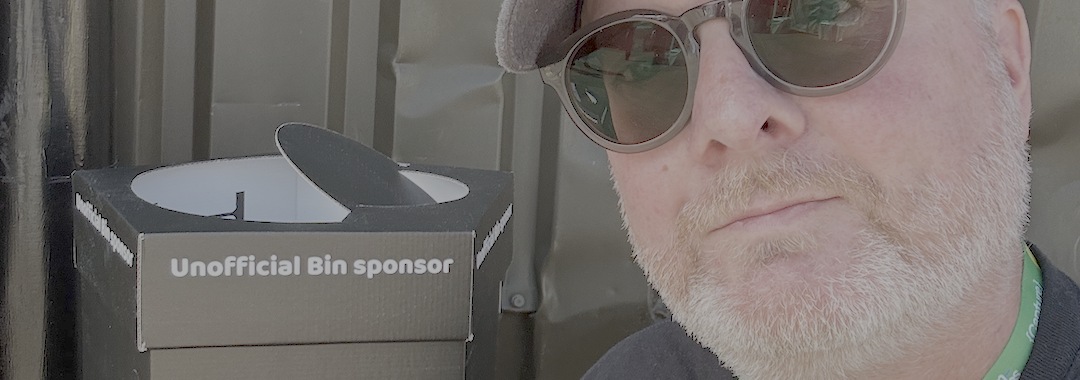
Let’s face it: yes, I’m “the bin guy.” The setting started as a joke on Twitter - just photos of the bins opposite my flat during lockdown when we were all grasping for something light-hearted. Yet it stuck. People remembered it, and soon enough, it became a distinctive brand asset, alongside the hat, known as Hat (also a lockdown purchase, more necessity than intention).
Neither the bins nor Hat were selected for any deep symbolic meaning. They simply became distinctive assets by accident, not grand design. And that’s the point - it’s not about forcing meaning, but about being memorably different.
The Distinctive Assets Grid
Jenni Romaniuk’s distinctive assets grid offers a clear lens: assets are assessed on two axes, fame and uniqueness.
Low uniqueness and low fame: Ignore or test.
Low uniqueness, high fame: Avoid using solo - think of Coca-Cola’s red. Lots of brands are red, so it’s just noise unless paired with unique elements such as the white ribbon.
High uniqueness, low fame: Invest. This is the sweet spot for most small businesses and solo operators. It’s where the bins and Hat sit for me - a tiny bit famous in a small circle, but unmistakably me.
High uniqueness, high fame: Use it or lose it. These are your gold dust assets.
Too frequently, brands invest in sales activation tactics such as PPC and SEO without thinking about what makes them stand out. What might make them memorable.
Visibility without recall is just more white noise.
Take Storm Mackay’s “Ramen Rascal” mascot - developed for Soba: Private Label.
Storm has invested in out-of-home campaigns, a bold green or yellow or who knows, let's just call it tennis call colour, a quirky tone of voice.
You see it, you remember it - even if you don’t entirely know why.
It just works.
I leaned in further too, dragging actual branded bins to events like MadFest and Digital Marketing World Forum.
Again, it’s not about meaning; it’s about memorable recall. When people remember “the bins” at an awards show, it doesn’t matter what they mean - association is everything.
Don’t Overthink It
People often get stuck looking for meaning. But think of some of the UK’s best-known insurance brands. Does the Churchill dog have any relevance to insurance? Of course not. But you remember “the one with the dog”, and that’s the point.
Distinctiveness needn’t be a revolution. It’s not always changing your logo or renaming your business. Sometimes, it’s as straightforward as just doing precisely the opposite of your competition.
How Do People Remember You?
Think of how you describe people: the guy in the green suit with the watermelon handbag, the one with the dreadlocks, the woman with the wildly oversized glasses.
These are the details that stick. Translated to business, they’re your distinctive assets - sometimes as trivial as a hat or, yes, a bin.
So, f you want your business to be remembered, resist the urge to conform. Look at what your competition is doing, then deliberately pull yourself away from it.
Be distinctive. Be memorable.
In business, it’s far better to stand out than blend in.
Right. The Obvious Questions Answered.
Why do so many businesses end up looking identical to their competitors?
Because looking at what competitors do and broadly replicating it feels safer than being different.
In B2B especially, category clichés get treated as signals of legitimacy. Legal businesses use scales and gavels. Tech businesses use blue logos and abstract shapes. Everyone uses words like "trusted partner" and "end-to-end solutions." Nobody stands out and everyone blends into an indistinguishable wall of credible-seeming similarity.
The irony is that none of this actually builds trust. It just creates noise. And in a sea of noise, the only thing that cuts through is being genuinely memorable. Which requires doing something different, not something familiar.
What are distinctive brand assets and why do they matter?
Distinctive assets are the things that make buyers recognise you without needing to see your logo or your name.
A colour. A character. A tone of voice. A visual style. A piece of music. A catchphrase. When developed consistently over time, these become mental shortcuts: when buyers see or hear them, they think of you automatically.
The key is that they need to be genuinely distinctive, unique to you in the category, and genuinely famous, widely associated with you. Assets that are neither can be ignored or dropped. Assets that are distinctive but not yet famous need investment. Assets that are both are gold and should never be abandoned without very good commercial reason.
How do we build distinctive assets without a big brand budget?
Start with what you already have, or what you can commit to consistently.
Distinctiveness doesn't require a rebrand or a national campaign. It requires consistent repetition of something specific to you: a visual element you use in everything, a tone of voice you maintain across all channels, a format, a phrase, a way of showing up that becomes reliably yours.
The bins and Hat are the most obvious personal example: neither cost anything, neither were planned as brand assets, and both became distinctive through consistent and committed use. The point isn't the production value. It's the consistency.
Isn't being distinctive risky? What if people don't like it?
Considerably less risky than being forgettable.
The goal of brand distinctiveness is not to be universally loved. It's to be remembered. Churchill's nodding dog has no logical connection to insurance. Nobody cares. They remember it and they associate it with the brand. That's the job done.
The risk of being distinctive is that some people won't resonate with you. The risk of being forgettable is that nobody will choose you. Given those two options, distinctive wins every time.
How do we know if our brand is actually being remembered?
Branded share of search is your most accessible proxy.
If more people are searching for your brand name over time, rather than just the generic category, that's evidence of growing mental availability. People know you exist and can recall you without prompting.
You can also simply ask. Customer research, even lightweight interviews with recent buyers, will tell you quickly how you came to mind, what they associate with you, and whether those associations are the ones you've been deliberately building. The gap between what you think you're known for and what buyers actually recall is always instructive. Usually humbling.
If this kind of thing is your bag, follow me John Lyons on LinkedIn for more practical and actionable tips and hints on doing more effective marketing.