Marketing Metrics That Matter for SMEs

Marketing doesn’t operate in a vacuum, and neither should it.
It has targets, metrics, KPIs and OKRs all designed to give some kind of insight into how marketing might be helping the business achieve it’s goals. Might. Many of them are disconnected from what really matters, but with a mantra of what gets measured gets managed (brilliant podcast by the way, get on it here) marketers often miss the wood for the trees.
So, let’s take a look at the metrics which matter and which can and should be tracked by every business, and in this case those which are affordable and clear for SMEs.
At the top of the business food chain they have budget for everything: brand trackers, econometric models, a steady pulse on just how present the brand is in minds and markets.
It’s comprehensive, invaluable, and to be blunt, expensive.
For most SMEs, that kind of investment is unrealistic, so the tendency is towards short-term metrics.
Return on investment (ROI), Return on ad spend (ROAS), attributable sales, the direct outcome of a campaign. If it moves, measure it.
This is not entirely a. bad thing, tracking sales activations and conversion is vital. Campaigns should have a clear sense of how money flows out and, crucially, what comes back in.
But it’s only half the story.
The best marketing works at two speeds: sales activation at the bottom of the funnel and creating brand awareness at the top of the funnel (for the purposes of this piece we’ll ignore the middle).
Of course, selling is easier when more people know the business – it’s obvious, but it bears repeating. The expansion of fame at the top of the funnel increases the size of the pool at the bottom of the funnel, but it doesn’t deliver instant results.
There’s a lag, and the uplift can be difficult to measure if you’re not specifically looking for it.
So how can an SME track the performance of their brand awareness marketing, that thing which has been proven to drive incremental growth?
My go-to here is share of search, specifically, branded share of search.
It's important to be clear here. Someone searching for the range of services in a given sector is entirely different from someone searching for a company they know offers those services. Typing a company name, or version of it, into Google is proof of mental availability.
They know of the business from somewhere, perhaps a previous campaign, word of mouth, or some other random exposure.
There is clearly brand awareness.
Tools such as Google Trends or MyTelescope provide a no or low-cost way for companies to track their share of search over time.
The first image below is a pie chart showing overall share of search for an agency. They currently have just 2.23% overall.
The second image is share of search over time, where we can see that they have in fact gone from just 1.43% share of search to 3.39% in a single month as a result of their marketing and advertising efforts, that's a solid 237% growth.
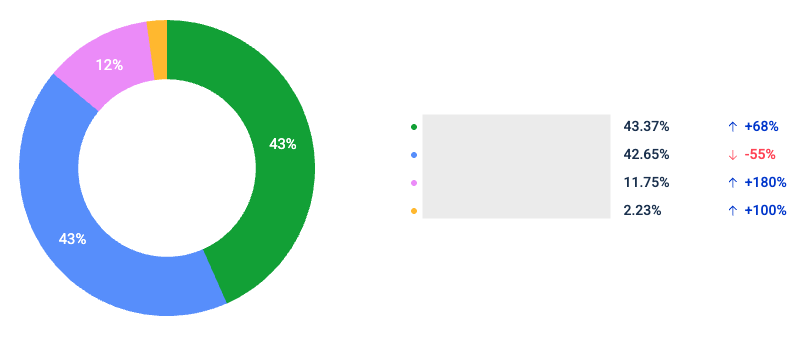
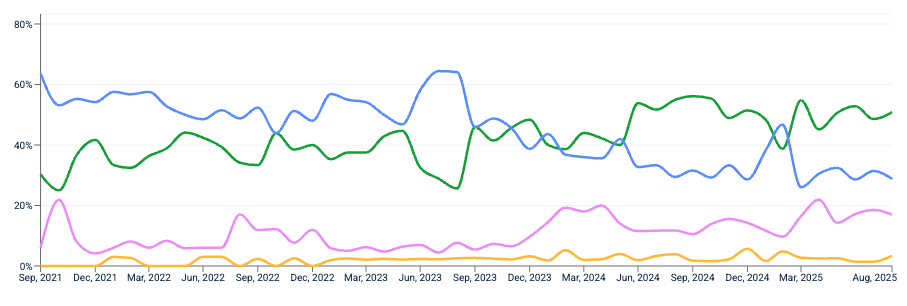
All you need do is benchmark your share of brand search with your competition, and don’t work too hard – it doesn’t have to be all of your competition. The goal isn’t to obsess over the absolute numbers but to observe the pattern: are more people searching for the brand this month than last and has my brand search increased against the competition?
It’s worth mentioning that, particularly for those with common names, the trick is to combine brand with category. Not just “John Lyons”, but “John Lyons Essex marketing”, or “John Lyons CMO”. It filters the noise and gives cleaner insight. After all, there’s no value to me in knowing who is searching for my namesake the actor or America’s Premier Horseman (never quite got over him grabbing the dot com of our name).
You could also track increases in direct visits and organic search volume to the website as a practical proxy for underlying brand strength and increased awareness. It’s imperfect, but useful at times.
Over time, as more people actively seek out the business, there’s a compounding benefit. In practical terms, it brings down the cost per acquisition.
To put it plainly, Coca Cola can acquire a customer more cheaply than an unknown niche player, not by magic, but because they’ve established fame. They’re easy to recall, and easy to find. Familiarity breeds lower friction and, by extension, greater efficiency in all bottom-funnel activity.
The advice then is simple. Track the bottom of the funnel: hard numbers, sales, new leads, conversions. At the same time monitor fame or brand awareness via branded share of search or direct hits to the website.
Don’t be side-tracked by the noise in the middle – click throughs, average open times, or similar metrics that may be interesting but are not essential. The focus ought to be on were people reached, and did something happen as a result that brings them closer to doing business?
Set up simple dashboards that tell the top and bottom of the story, follow and unpick the patterns and adjust course as necessary.
Respond to the facts on the ground, not the hype.
Ultimately, effective marketing should be measured sensibly and firmly rooted in commercial reality.
This approach to measurement is practical, affordable, and entirely within reach for most growing businesses. It might not have the glamour of a big-budget analytics suite, or the amazing detail of brand tracking (and I am a huge advocate of brand tracking) but as ever, what matters is whether it helps drive results and make sense of your marketing activities.
If this kind of thing is your bag, follow me John Lyons on LinkedIn for more practical and actionable tips and hints on doing more effective marketing.