HOW INVERSITY LAUNCHED A NEW BRAND INTO A TRADITIONAL MARKET IN 8 WEEKS
Case study: Inversity

SNAPSHOT
Client: Inversity
Sector: EdTech / practical AI training
Market: UK, Greater Liverpool region
Target customers: Two distinct ICPs: subject leads (heads of maths, heads of computing/CST) and school and career leadership (principals, heads, career leads) at sixth form colleges and schools
Challenge: New brand, no awareness, no direct competitors, a traditional and relationship-driven target market, and a need for fast results on minimal investment
Work delivered: Brand strategy and positioning, multi-channel brand launch and lead generation campaign, campaign positioning, direct mail creative, digital display, email and LinkedIn outreach sequences, telesales
Timeframe: 8 weeks in flight
Headline result: At least 45% of the total addressable market reached across multiple channels. Hackathon at full capacity.
"With a very new business and minimal investment in brand, this was as much of a test of concept for Inversity as anything else. But I was impressed with the boldness of John and Storm's vision and the rigour behind the planning. It was also a lot of fun, and I learned a lot too. First Liverpool, next the world!"
Dr James Kuht MBE, Founder, Inversity
THE SITUATION
Inversity was an EdTech start-up offering practical AI training to schools and sixth form colleges, courses and workshops designed to give students hands-on AI skills rather than theory. An excellent practical product with clear customer benefits, and a founder who knew exactly who he wanted to reach.
The challenge was everything else. No brand, no presence. No awareness. No competitors to benchmark against, and in truth no category as such at that time. Add to that a target market, school and college leadership, that is traditionally conservative, deeply relationship-driven, and not especially easy to reach through conventional digital channels.
The brief was to launch first in the Greater Liverpool region, build awareness among local school and college leaders and drive leads for entry-level AI masterclasses and hackathon challenges. Eight weeks. Total addressable market of 88 institutions.
THE PROBLEM
Totally new brand in a newly developing category, with a very traditional target market and no runway for a long brand-building programme.
Inversity had two distinct ICPs to speak to simultaneously. Subject leads, specifically heads of maths and computing, who would understand the curriculum relevance and want the detail. And school and career leadership, principals, heads and career leads, who needed to understand the strategic case for getting their students AI-literate before the conversation moved further up the agenda than they were comfortable with.
Both needed to hear from Inversity. Neither had heard of Inversity. And the window to get cut-through before the campaign budget ran out was short.
The answer was not to play it safe.
THE STRATEGY
Two things were clear from the outset.
First, a standard email and digital campaign was not going to cut through to an audience that is bombarded with EdTech vendors and largely ignores them. Second, with a total addressable market of 88 schools, this was not a broad reach problem. It was a precision targeting problem with a creative solution at its centre.
The strategy was to develop an identity and value proposition that would land instantyly, and follow up with a multi-channel campaign, sequenced, and built around a single arresting idea designed to get Inversity into rooms it had no right to be in yet.
The two ICPs required different conversations, but the same initial hook: something bold enough to make a school leader stop, look twice, be able to recall the brand as other media channels kicked in and pass it to a colleague.
THE BIG IDEA
The campaign centred on one question:
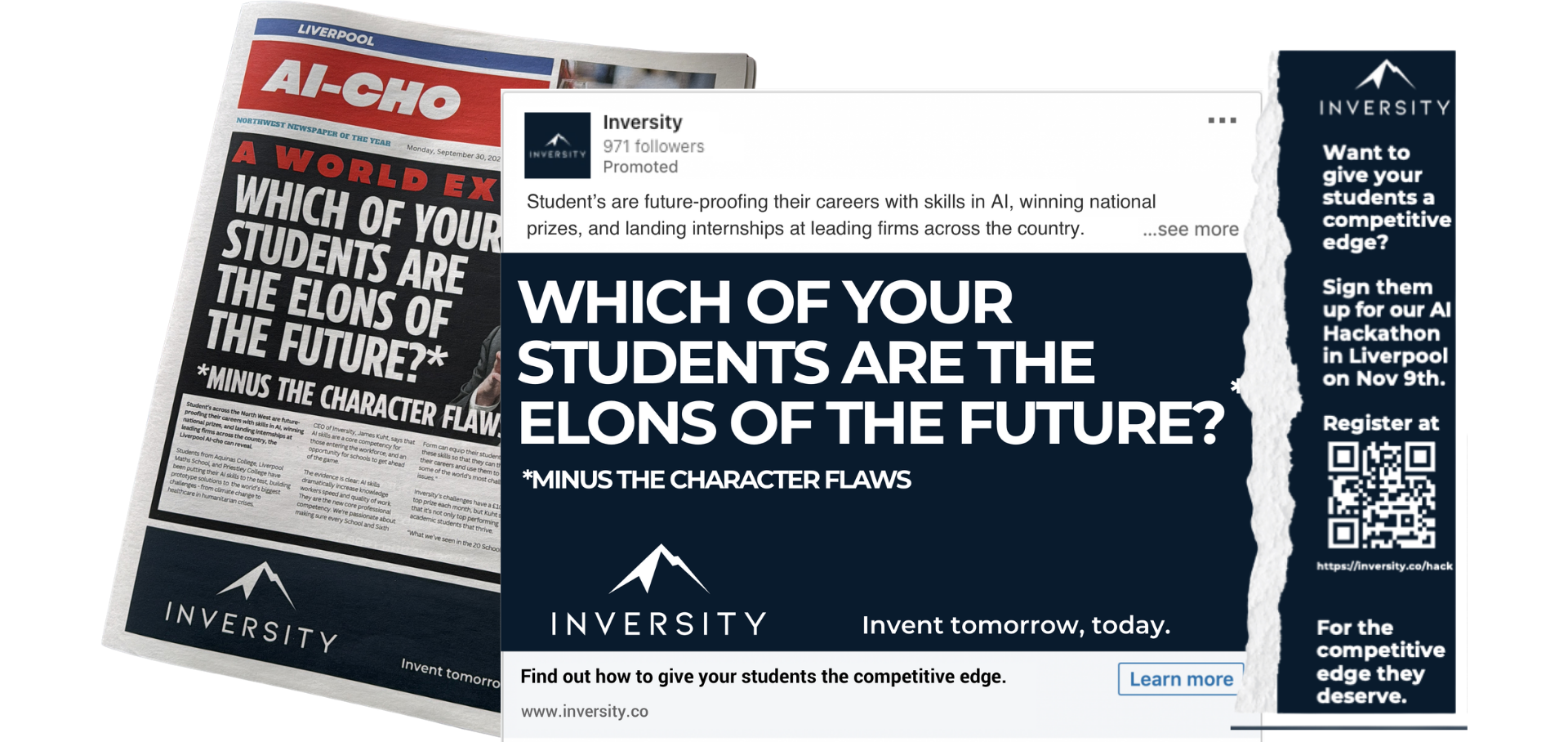
WHICH OF YOUR STUDENTS ARE THE ELONS OF THE FUTURE? *minus the character flaws
To be clear, this was before DOGE and turning up to support nationist groups worldwide, but even then the world's richest man split the room. And that is precisely why it works. It's better to split the room than not get into it at all.
A front page that references Musk does not get filed quietly in a recycling bin. It gets read. It gets shown around the staffroom. It earns the five seconds of attention that makes everything else possible.
The vehicle was a bespoke direct mail piece designed to look like the local newspaper, The Liverpool Echo, named the Liverpool AI-Cho. A full newspaper format, with bespoke articles and advertising about Inversity, dropped into schools with the credibility of something that looked like it belonged on a newsstand rather than a vendor's mailing list.
From there, the campaign moved through a sequenced set of channels: region and institution targeted digital display, two email outreach sequences, two LinkedIn outreach sequences, and telesales.
Each channel reinforced the last. The comms shifted register as the campaign progressed, moving from the bold creative hook into the more underlying "Invent tomorrow, today." positioning developed for the brand.
Free-to-attend events served as the conversion mechanism: a webinar, introductory in-person events, and a hackathon challenge, each designed to bring the right cohort into a room with Inversity and let the product do the rest.
RESULTS
In eight weeks in flight, at least 45% of the total addressable market of 88 institutions were reached through one or more channels.
88
Institutitions targeted
45%
of total addreassable market reached
100%
Hackathon capacity filled
The webinar and introductory events grew awareness and created the first real conversations with both ICPs.
The hackathon was full. For a brand that did not exist in this market eight weeks earlier, that is a meaningful result.
WHY IT WORKED
The temptation with a new brand in a new category is to play it safe, explain what you do, make it look credible, and hope the right people find it. That approach would have been invisible here.
In truth it would be invisible almost everywhere.
What worked was precision combined with boldness. The total addressable market was small enough to treat every institution as a named target. The creative was distinctive enough to force attention in a market that had learned to ignore vendor communications. And the sequenced channel approach meant that by the time telesales called, they were following up on something the contact had already seen, not arriving cold.
The product also helped. AI training for students is a genuinely compelling proposition for school leadership right now. The campaign did not have to manufacture urgency. It just had to get Inversity in front of the right people before someone else did.
RELEVANT SERVICES
Brand strategy, positioning, ICP definition, creative concept, direct mail, digital display, email outreach, LinkedIn outreach sequences, telesales coordination, event strategy, campaign positioning.
THE CLOSING LINE
New brand. New category. Traditional market. Eight weeks.
If the brief is that tight and the window is that small, you can't afford to be forgettable. You have to earn attention fast, then give people a reason to act on it.