Your Brand Assets Probably Aren’t Distinctive
Most B2B businesses aren't distinctive.
They have a logo. They have a colour palette. There's probably a PowerPoint somewhere explaining that blue represents trust, green represents growth and that some painfully selected typeface represents innovation.
Amazeballs.
So do most of your competitors.
The point of distinctive brand assets isn't just to look different. It's to create things people recognise and connect specifically with you.
Because recognition makes you easier to remember, easier to consider, more choosable and ultimately easier to buy.
That's the bit that matters.
Distinctiveness and differentiation aren't the same thing
First, an important distinction.
Differentiation is why somebody might choose you.
Distinctiveness is how somebody knows it's you in the first place.
They're entirely different jobs, and good businesses should be thinking about both.
Your differentiation might come from what you offer, how you solve a particular problem, the experience you provide, your expertise or something else buyers value.
Your distinctive assets help those same buyers recognise you when they encounter you again. Like when they are next in market for whatever it is you sell.
There's a really simple test for this.
Take your logo off your website, advertising or social content.
Would somebody who knows your business still recognise that it came from you?
Now try the same thing with your tagline. Put it on your biggest competitor's website.
Does it still work?
If it does, you've probably written another interchangeable B2B line about transforming businesses, delivering excellence or empowering tomorrow.
Get it in the bin.
If your competitors could use your words, colours, imagery and layout without anybody noticing, those things aren't doing enough work for your brand.
Your logo isn't your brand
B2B has a particular problem here because entire categories tend to settle into the same visual language.
Cyber security businesses like dark blue because apparently dark blue means serious. Technology businesses love gradients. Professional services companies enjoy photographs of suspiciously attractive smiling people pointing at Post it notes through glass walls.
Everyone follows the category conventions because it feels safe.
And then everyone wonders why nobody remembers them.
Your logo and colour palette can absolutely become distinctive assets. But simply having them doesn't make them, or you, distinctive.
They have to become associated with you.
That can include colours, shapes, characters, sounds, phrases, imagery, typography, your tone of voice and the way you repeatedly turn up in the market.
Words matter here. More than you might realise.
Read five B2B professional services websites and you'll usually find the same polished turds. Professional. Trusted. Innovative. Client focused. Tailored solutions.
Nobody remembers any of it because nobody could tell you which company said it.
That's not branding, that’s a sea of same.
A distinctive brand should look recognisably like you and sound recognisably like you.
Distinctive assets are built, not announced
There's another problem.
Businesses create a new brand ‘asset’, use it three times, get bored and replace it.
That's not how recognition works.
Assets become valuable through repeated, consistent use over time.
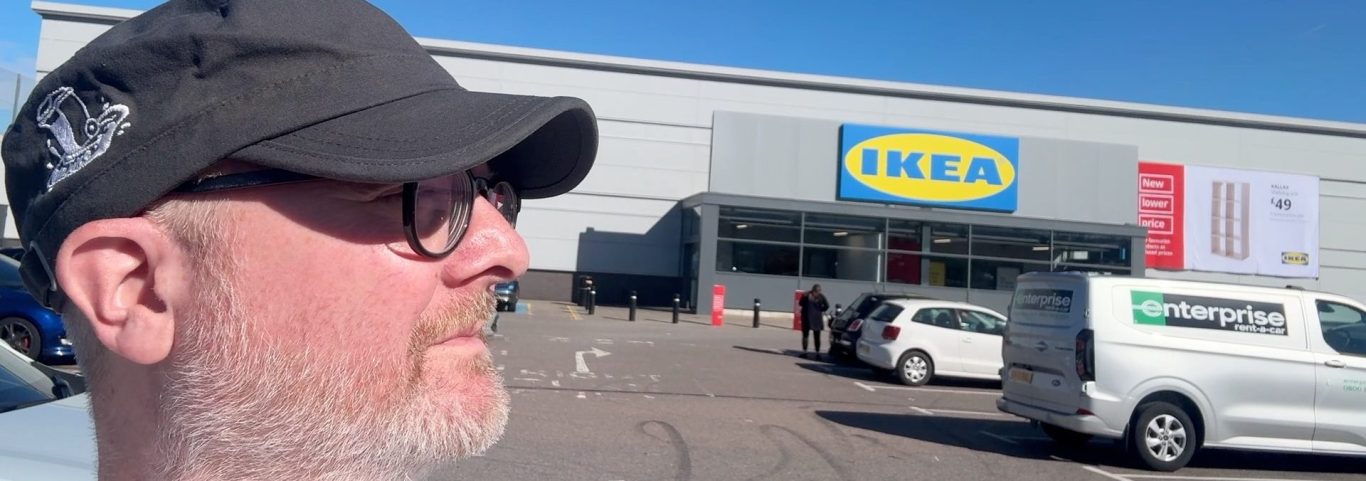
I'm not associated with Hat because I wore it once.
I've worn the fucking thing for years.
It’s on my head when I record Bin Juice, when I speak at events, on social media and throughout my visual identity. The same is true of the bins and Bin Juice itself.
They're repeated.
Again and again.
Long enough for other people to make the association without me explaining it.
IKEA recently launched something called Great British Bin Juice. I completely missed it myself, but other people started tagging me into posts about it.
That's when you know an association has formed. Something entirely unrelated to me triggered the memory of me.
Likewise, when I first met Molly Scanlan and tried to get past her to throw away a paper cup, she immediately knew who I was.
"The bin guy."
Twenty plus years in marketing and this is my bloody legacy.
Brilliant.
But commercially, it works.
System1 describes good creative as having the opportunity to "wear in, not wear out", and I think it was Uncensored CMO Jon Evans formerly of System1 who I first heard use the brilliant phrase “familiarity breeds contentment”.
We get bored with our branding much faster than customers do, and that’s a stupidly dangerous reason to change it.
Think very carefully before you rebrand
Businesses regularly decide their branding looks a bit old.
Fine.
But old isn't necessarily bad.
Old can also mean familiar.
And familiarity can have considerable commercial value.
A full rebrand can mean throwing away years of accumulated recognition and brand equity because somebody decided the logo needed to look more contemporary. Which is often code for it needs to look more like our competitor who just changed theirs.
That's an expensive way to scratch a creative itch.
There's a reason conversations in marketing circles about rebranding come back to the same concern: what existing recognition, trust, search visibility or customer familiarity will disappear with the old identity? Business owners considering rebrands explicitly worry about losing recognition and confusing existing customers.
Sometimes a complete rebrand is necessary.
Businesses change. Markets change. Companies merge. A brand can become actively unhelpful.
But quite often what you really need is maybe a refresh, or a sharpened position.
Keep the equity that already exists. Strengthen the useful assets. Remove the generic rubbish. Make the brand more distinctive and easier to recognise.
Don't burn the house down because somebody doesn't like the curtains (though if it has an artex ceiling, kill it with fucking fire immediately).
Recognition has commercial value
This isn't an argument about making things look prettier.
I couldn't care less about prettier.
Prettier is subjective, and anything subjective has no place in marketing or branding.
This is about making your business easier to recognise when somebody encounters it and easier to remember when they eventually need what you sell.
Does it objectively do the job. That’s it. That’s all that matters.
Most potential B2B buyers aren't walking around thinking about your brand.
They have jobs, they have lives, they have an almost exhaustive list of anything and anything that they think about before your brand.
Who’d win in a fight, a baboon or a badger? What would happen if I stapled my thumb (my mate Ricky thought this once, apparently it really hurts. Who knew).
When a need appears, you want your business to be one of the names that comes to mind and one of the brands they recognise when they start looking for a solution.
Distinctive assets increase your chances of that happening.
So audit what you've already got.
Look at your colours, language, imagery, typography, characters, phrases, layouts, sounds and anything else you repeatedly use.
Then ask two brutal questions.
Would somebody recognise this as us without seeing our name?
Could one of our competitors use exactly the same thing?
If the answers are no and yes, respectively, you've got work to do.
Because being distinctive isn't about winning a design award.
It's about becoming recognisable enough to be remembered, considered and bought.
That's where the money is.
Right. The Obvious Questions Answered
What makes a brand asset distinctive?
A brand asset is distinctive when people recognise it and associate it specifically with your business.
Being unusual isn't enough.
You could paint every presentation fluorescent orange and put a badger on the homepage. That's different, but until people repeatedly connect those things with your business they're just fluorescent orange and a badger.
Distinctiveness comes from association and repetition.
The asset needs to be identifiable as yours, not just something your design team likes.
Is a logo and colour palette enough to make a brand recognisable?
Usually not.
They're useful assets, but they're only two of the tools available to you.
Strong brands can also build recognition through language, typography, characters, imagery, sounds, layouts, Mascots, phrases and consistent ways of behaving or communicating.
The useful test isn't "do we have brand guidelines?"
It's whether somebody can encounter something you've produced without seeing your company name and still know it's you.
If removing the logo makes your business disappear, you've probably got a logo rather than a distinctive brand.
What's the difference between differentiation and distinctiveness?
Differentiation gives somebody a reason to choose you.
Distinctiveness helps them recognise and remember you.
You want both.
Being highly differentiated but completely forgettable isn't overly useful. Being incredibly memorable without giving customers a decent reason to buy isn't much better.
One helps persuade.
The other helps make sure you're actually in the room to persuade in the first place.
Should I rebrand if my branding looks outdated?
Not always.
Ask whether the existing identity is actually damaging the business or whether you've just become bored with it.
Those are not the same problem.
If customers already recognise your existing assets, replacing everything could destroy useful brand equity. A refresh might let you improve the identity while retaining the elements people already associate with you.
Change should solve a commercial problem.
"Dave thinks the logo looks a bit 2018" isn't one.
How long should we keep using the same brand assets?
As long as they're continuing to build useful recognition.
There isn't a magic number of months or years.
The mistake is assuming people are as exposed to your marketing as you are. You've seen the campaign 147 times because you approved the fucking thing. Your potential customer may have noticed it twice.
Consistency gives assets time to become familiar and connected with your business.
So don't change things just because your internal team is tired of looking at them.
If an asset is becoming increasingly recognised as yours, that's not the moment to kill it.
That's the moment it's finally starting to earn its keep.
If this kind of thing is your bag, follow me John Lyons on LinkedIn for more practical and actionable tips and hints on doing more effective marketing.